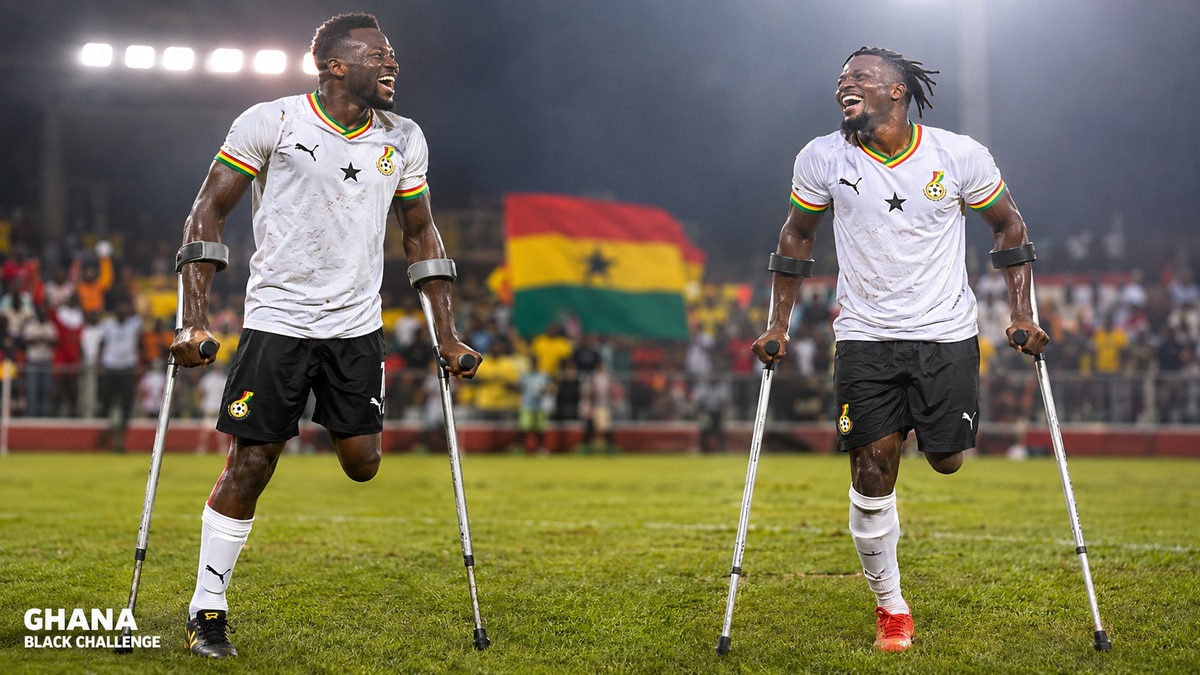
Amputee football | World Cup | 21 November 2026
A penalty shootout can compress years of ambition into a few moments. Ghana’s Black Challenge held their nerve against defending champions Türkiye, winning 4–3 on penalties after a 1–1 draw to reach the 2026 amputee football World Cup final. It is the national team’s first appearance in the title match. Their achievement also carries broader significance for the tournament: Ghana will meet Morocco in an all-African final after both teams came through contrasting semifinals in Mexico.
A goalless contest became a test of temperament
For the first 50 minutes of regulation time, neither side found a breakthrough. Türkiye’s experience as reigning champions made the task formidable, but Ghana refused to become passive. The scoreline stayed level because both teams kept defending important spaces and neither could convert pressure into a decisive finish. Such matches are difficult to read from the final score alone. The longer the stalemate lasts, the greater the pressure on every chance, foul and restart.
Mubarik’s seventh goal was not quite the final word
Nine minutes into extra time, Ghana finally moved ahead. Mohammed Mubarik, the tournament’s leading scorer, converted a penalty to take his tally to seven goals. The moment appeared to bring the Black Challenge within sight of history, but Türkiye responded before the additional period had ended. The equaliser changed everything again. Ghana had already overcome the challenge of taking the lead against the champions; now the players had to absorb the disappointment of losing it and prepare for penalties without surrendering belief.
Four successful penalties settled the semifinal
The contest grew more difficult when Ghana’s Hamza Mohammed and Türkiye’s Kemak Gules were both sent off, leaving each side a player short. That heightened the physical and emotional demands before the shootout. Ghana eventually prevailed 4–3, with Mubarik, Richard Arthur Opentil, Yussif Yahaya and Timothy Hayford converting their efforts. Türkiye missed twice. The margin was narrow, yet the result was the product of maintaining composure after a match full of changing expectations.
The shootout rewarded composure after chaos
Penalty shootouts often generate a temptation to call the winner fortunate and the loser unlucky. That overlooks the preparation and confidence required to take decisive kicks after a draining encounter. Ghana’s conversions did not erase the tension of the earlier minutes; they gave it meaning. The Black Challenge had previously failed to progress beyond the quarterfinal stage of the competition. To eliminate the defending champions in this fashion represents a marked change in the team’s place within the international game.
The road to the final was anything but smooth
Ghana did not arrive at this stage through an uninterrupted sequence of wins. Their tournament began with a 2–0 defeat to Angola and a 1–1 draw with Colombia. Those results made the third group match against Iraq critical. A 6–0 victory provided the response required to progress, but it also marked the start of a more convincing phase of the campaign. The side found a sharper way of attacking and began to convert control into goals.
In the knockout rounds, Ghana beat the United States 3–1 before defeating Egypt 2–0 in the quarterfinals. Mubarik scored twice against Egypt, reinforcing his role as the team’s most dependable finisher. The progression tells a more interesting story than the semifinal alone. Ghana have had to correct their course, handle elimination pressure and then meet the strongest side in the competition’s recent history. Those demands make the final appearance feel earned rather than accidental.
Morocco make the final an African landmark
Morocco reached the title match by coming from behind to defeat Brazil 2–1. They have won all six of their matches at the tournament, a record that speaks to both quality and consistency. The final is scheduled for Sunday in San Juan de los Lagos, Mexico. It will be the first all-African final in the event’s history, a milestone with significance well beyond whichever team eventually lifts the trophy.
There is also useful recent history between the finalists. Ghana beat Morocco 2–1 in the 2024 African Amputee Football Cup of Nations final to retain their continental title. That result provides context, not a guarantee. World Cup matches bring different conditions, and Morocco arrive with an unbeaten campaign behind them. Ghana will need the defensive discipline displayed against Türkiye and the attacking precision that carried them through the knockout stages. The balance between those qualities is likely to define the final.
A first final already represents a breakthrough
The Black Challenge have achieved something no previous Ghanaian amputee World Cup side managed. The team that began with a defeat and a draw is now a single match from the title. Ghana vs Morocco promises an unusually compelling final because both nations bring continental experience and different tournament journeys. The result will determine the champion, but it cannot erase the significance of the semifinal. By overcoming Türkiye under intense pressure, Ghana have given themselves the strongest possible stage on which to demonstrate how far their football has progressed.