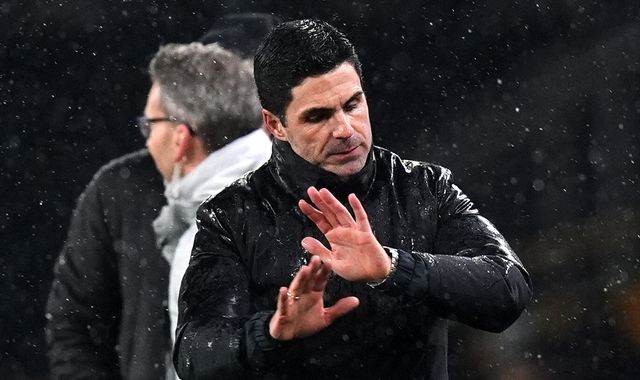
In a season where every headline tries to pull you forward, Mikel Arteta is pushing Arsenal in the opposite direction. Ahead of a high-pressure trip to Tottenham, the Arsenal manager has asked his players to “live in the present” a phrase that sounds simple, but lands with real weight when a title race begins to tighten.
At this stage of the Premier League calendar, the temptation is obvious. Fans start counting points. Pundits start mapping the run-in. Rivals start talking. Inside a dressing room, that noise can become a distraction, or worse, a subtle excuse. Arteta’s point is that none of it matters if Arsenal don’t win the next action, the next duel, the next match.
That message feels especially relevant after a week that reminded everyone how quickly momentum can shift. Arsenal have dropped points in successive league games, and the gap behind them has narrowed. The lead is still there, but the comfort has gone. That changes the emotional temperature of every fixture especially a North London derby.
Two Draws That Changed the Mood
Arsenal’s recent results have been a mix of warning signs and lessons. The draw at Brentford was frustrating but manageable. The late slip at Wolves, however, stung more. Conceding late after being in a strong position is the kind of moment that invites doubt from the outside world, even if the internal message stays calm.
Those points dropped have created a familiar dynamic: a chasing pack that suddenly believes again. Manchester City remain the obvious threat, sitting just five points back with a game in hand. That reality doesn’t require panic, but it does demand precision. The margin for error becomes thinner. A “good” performance without a result starts to feel expensive.
Arteta has not framed this as a crisis. He’s framed it as a truth: Arsenal are exactly where they want to be, but they still need to earn everything. That tone matters. It’s leadership by standards, not by emotion.
Why “Live in the Present” Is a Competitive Strategy
There’s a reason elite teams talk about focus in almost boring terms. Big targets can create paralysis. Players start thinking about consequences rather than decisions. In contrast, the best sides reduce complexity. They narrow the lens to controllables: intensity, spacing, duels, transitions, and finishing.
That’s what Arteta is chasing with his message. The present isn’t just a motivational line. It’s a competitive strategy. It keeps the team sharp. It stops them from carrying the weight of “what if” football. And it removes the false comfort of talking about future outcomes instead of current actions.
It also fits Arsenal’s broader situation. They are still competing on multiple fronts, with a League Cup final reached and progress made in Europe and domestic cup football. Those are positives. But multiple competitions can also stretch focus. A derby, in that context, becomes a test of mental discipline as much as tactical quality.
The Tottenham Factor: Rivalry, Pressure, and a New Direction
Derbies rarely follow a script. Form can matter less. Emotion can matter more. That’s why Arteta’s calm approach is important. Arsenal do not need to be “hyped” for a match like this. They need to be controlled. The goal is to play with edge without losing structure.
Tottenham Hotspur also enter the fixture with a different energy under new management. A fresh coach can change patterns quickly pressing triggers, build-up shapes, and the risks a team is willing to take. Arteta has acknowledged that Arsenal have done their homework, looking at what Spurs have shown recently and what their manager has preferred in the past.
Still, the core idea is clear: understand Spurs, but don’t get dragged into their game. In derbies, the team that keeps its identity usually has the clearer route to control.
Team News and the Value of Key Returns
Arsenal may receive timely boosts. Martin Ødegaard and Kai Havertz have been monitored closely, and their potential availability adds flexibility. Ødegaard changes Arsenal’s tempo and decision-making between the lines. Havertz adds another profile in attack movement, link play, and a different kind of threat in the box.
There is also reassurance on Bukayo Saka, who has been a constant reference point for Arsenal’s right-side threat. In games like this, having your most decisive wide player available is not just helpful it’s strategic.
Even so, Arteta’s framing suggests he doesn’t want this game to become a conversation about missing pieces. He wants it to be about standards. That includes players who start, players who come off the bench, and players who must deliver in difficult moments.
The Real Test Is Not the Occasion. It’s the Response.
Arsenal’s strongest claim this season has been their growth in maturity. The next step is proving that maturity under pressure, away from home, in a rivalry environment, with the title race tightening behind them.
Arteta’s message is a reminder that championships are not won in the future. They are won in the present in the next sprint, the next tackle, the next decision to stay brave on the ball. Derby days can feel emotional. Champions treat them as execution days.
If Arsenal do that at Tottenham, it won’t guarantee anything in May. But it will reinforce something more important right now: that this team can hold its nerve when the season starts to feel heavy. And in a title race, that is often the separating factor.